



‘Greet Andronicus and Junia, my fellow Jews who have been in prison with me. They are outstanding among the apostles, and they were in Christ before I was.’ (Romans 16:7 NIV2011)
I suspect for many Christians reading their NIV, KJV, NLT or NRSV Bibles, any question of the identity of the second person named in Romans 16:7 is simply a non-issue. After all, with complete sincerity they could affirm what Williams contends: ‘Was there a woman apostle? Yes. Her name was Junia. How do I know? Because the Bible tells me so’.1 However, one only need consult the likes of the NASB, CSB or ESV translations, and we quickly discover that there exists a level of disparity within our English Bibles: first, whether the original Greek word Ἰουνιαν should be understood as a male or female (i.e. as Junias or Junia); and second, whether or not Paul bestowed the apostolic title upon him or her? What could be said to those who claim that Ἰουνιαν was neither a woman nor an apostle, or who assert that we simply cannot know?
In order to consider this textual issue and arrive at a conclusion, it is expedient to address each challenge in turn. Therefore, I have structured this essay into the three major considerations of this debate, following Schreiner’s helpful summary: ‘First, is Paul referring to a man or a woman? Second, are Andronicus and Junia(s) outstanding in the eyes of the apostles, or are they outstanding apostles themselves? Third, is the term ‘apostle’ used as a technical term, or is it used nontechnically to refer to missionaries?’2 Taking into account these three considerations, I will argue that Ἰουνιαν (Junia) was both a woman and an apostle.
Before proceeding, I must acknowledge that virtually all academic commentary on the textual issues in Romans 16:7 is inevitably presented within an individual’s underlying bias toward the suitability of women serving in leadership ministries. As such, it is no surprise that publications seeking to limit the leadership of women present a doubtful or negative assessment of Junia’s apostleship.3 Conversely, those that espouse an egalitarian position will tend to do the opposite, elevating Junia to a rank potentially beyond that which the text suggests.4 It is outside the scope of this essay to comment on the implications of this verse for the larger theological discussion of women in ministry, however we must acknowledge that the existence of a female apostle does contribute to the debate in ways that make some positions more difficult to defend.
JUNIA THE WOMAN?
First, we must determine whether Ἰουνιαν, was a man or woman. And we are immediately presented with a textual problem which is only visible in the Greek of Romans 16:7:
ἀσπάσασθε Ἀνδρόνικον καὶ Ἰουνιαν τοὺς συγγενεῖς μου καὶ συναιχμαλώτους μου, οἵτινές εἰσιν ἐπίσημοι ἐν τοῖς ἀποστόλοις, οἳ καὶ πρὸ ἐμοῦ γέγοναν ἐν Χριστῷ.5
Lexically, the name ‘Ἰουνιαν’ appears in this verse in the singular, accusative case, functioning as the object of the imperative verb ἀσπάσασθε (‘you° must greet’), and is the only occurrence of the name in the Greek New Testament.6 The issue arises when we attempt to determine the dictionary form of Ἰουνιαν, since both the feminine name Ἰουνία (‘Junia’) and the postulated masculine name Ἰουνιᾶς (‘Junias’), would legitimately decline to the accusative form shown above.7
Based on this lexical indistinction, Piper and Grudem in their partiality are quick to instil doubt for anyone wishing to determine Junia’s gender with any degree of confidence. They write: ‘Was Junias a woman? We cannot know. The evidence is indecisive’.8 However, when we examine this evidence, their assertion proves to be baseless—the evidence, rather serves to reinforce the validity of Junia being a woman.9
English Translations of Ἰουνιαν
The permissible flexibility in the underlying Greek gave rise to some prominent translations which render the name as ‘Junias’ (NASB, ASV, CEV, MSG and others). Though as Preato helpfully observes, these translations that handled Ἰουνιαν in this masculine manner arrived relatively late on the English scene, ‘not until the latter half of the 1800s’.10 By contrast, the vast majority of English translations since their emergence in the thirteenth century up to the present era consider Ἰουνιαν to be a woman.11 Preato then augments this majority with several additional Bibles which have undergone revisions, and now correctly translate Ἰουνιαν as a woman. These include the NIV, NRSV, and the overtly complementarian ESV.12 Based on the weight of English translations leaning in one direction, we could prematurely conclude that the feminine ‘Junia’ appears to be the more accurate rendering. However, to determine the legitimacy of this translation we must now investigate the ancient name in more etymological depth.
Ἰουνιαν in Biblical Source Material
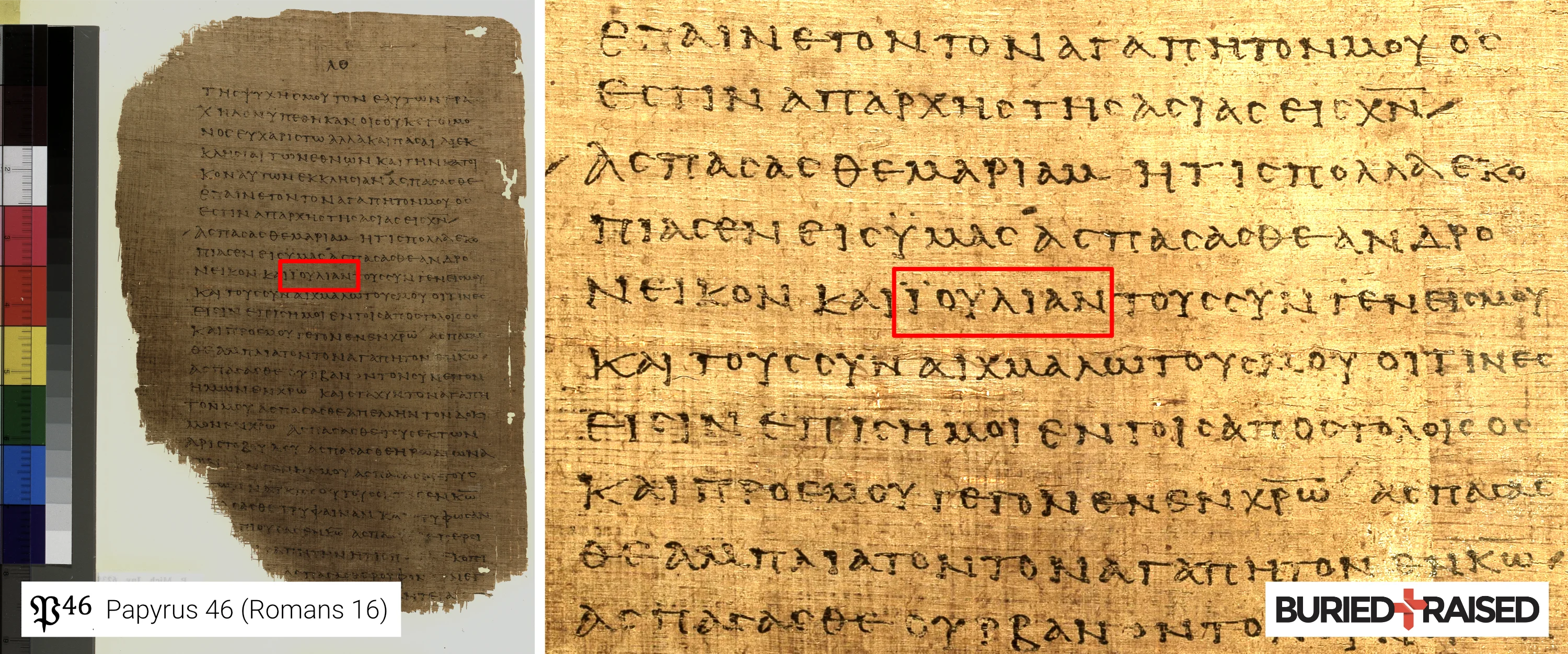
We must first examine a survey of Greek manuscripts of Romans 16:7. Thorley provides an excellent survey of the primary source materials. He writes: ‘The earliest extant manuscript which contains Rom. 16:7 is 𝔓46, dating from the late 2nd or early 3rd c. Here the reading is quite clearly ΙΟΥΛΙΑΝ’, this minor variant ‘Julia’ occurring in five manuscripts, and in the eyes of Epp, only further confirms that a woman’s name was originally in the text.13
An examination of the fourth century majuscule Codex Sinaiticus (א 01) yields the name ΪΟΥΝΙΑ (curiously rendered without the typical concluding Nu).14
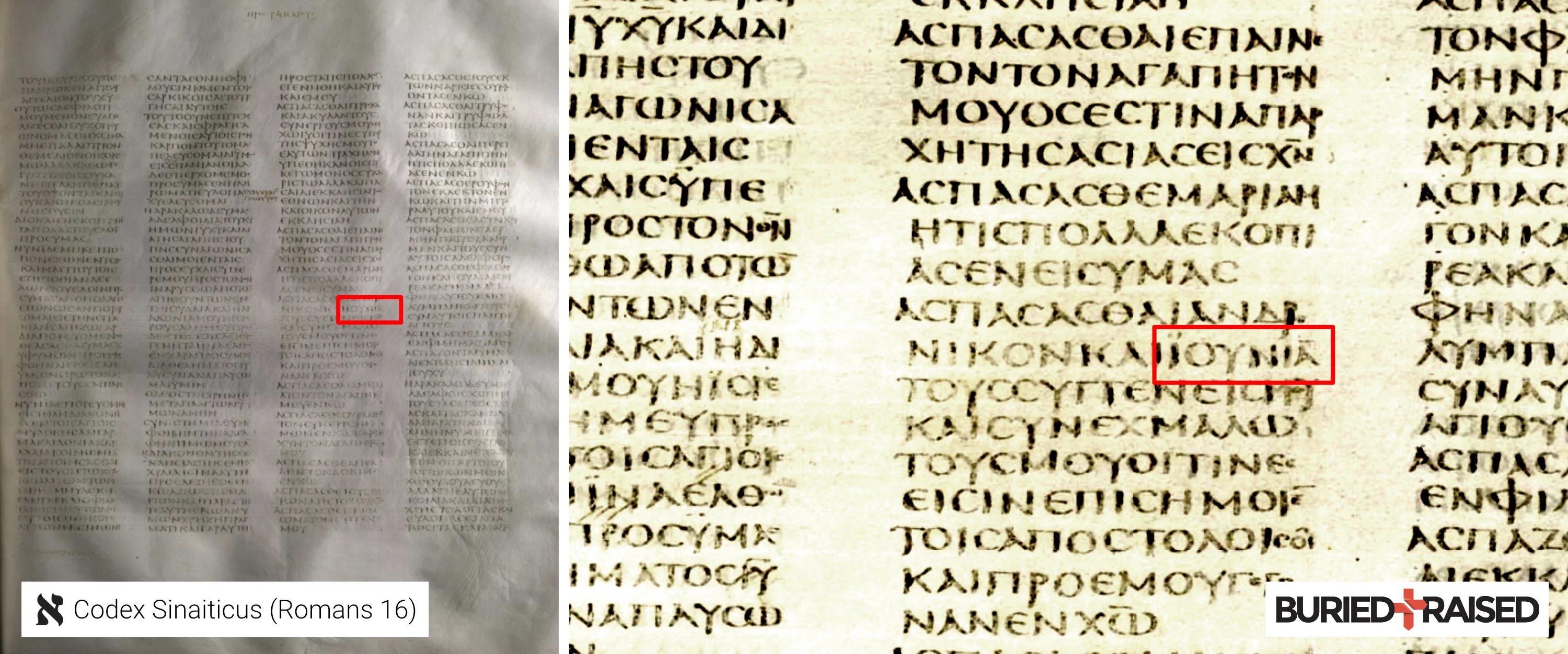
These early Greek texts contained little—if any—accents, with accentuation becoming common with the prevalence of the minuscules in the ninth century. It is not insignificant ‘when Greek manuscripts began to be accented, scribes wrote the [acute] feminine Ἰουνίαν’ form.15 Thorley concedes that while these early unaccented sources do not prove the masculinity or femininity of the name, ‘the obvious way to read the name is as the accusative of a feminine form JUNIA (in Greek Ἰουνία in the nominative)’.16 This assessment appears correct, as we can verify that the ninth century minuscule number 33 (dubbed ‘Queen of the minuscules’) contains the acute accented form: Ἰουνίαν.17

Additionally, the 12th century minuscule GA 620 very clearly shows this same acute accentuation.18
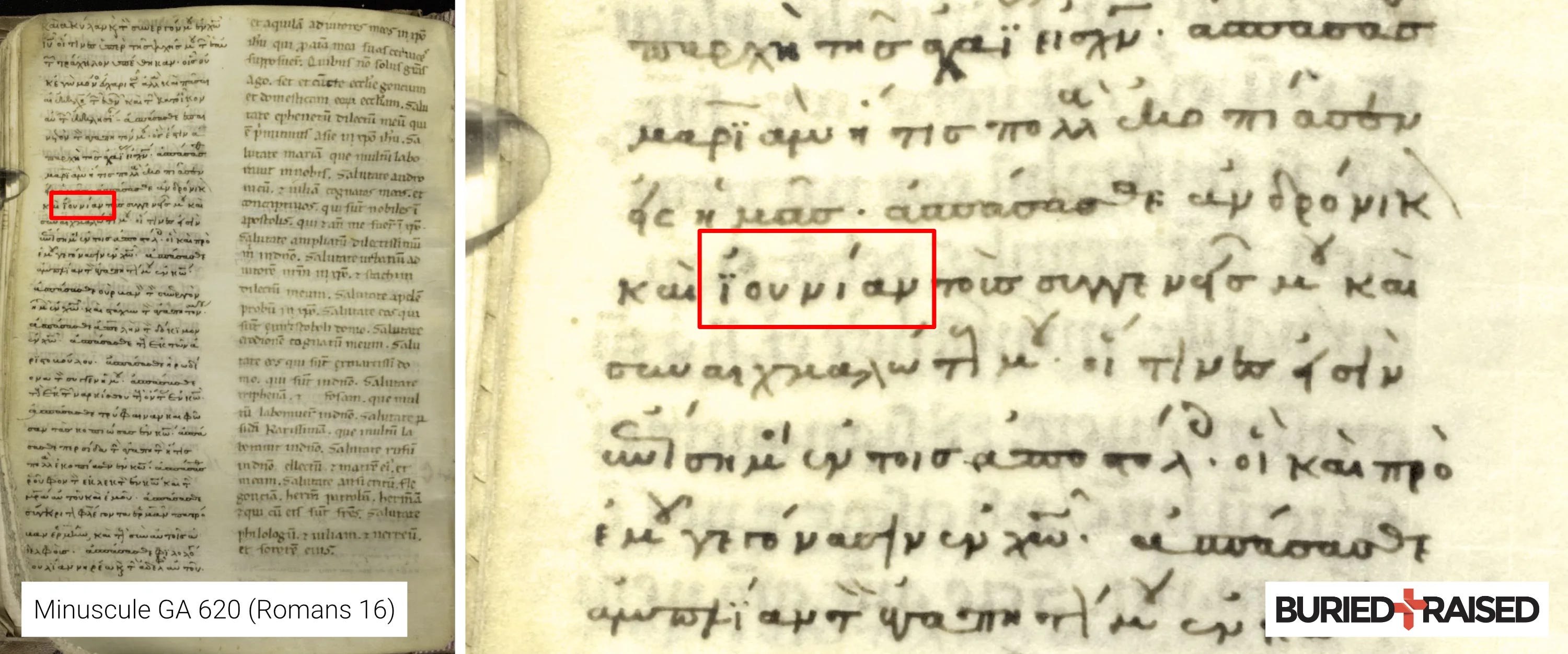
Thorley remains confident that all the minuscules render Junia’s name in this feminine manner.19 If the evidence from the Greek New Testament sources is overwhelmingly feminine, we do need to ask: How it is that some reputable modern Bibles could justifiably render Ἰουνίαν as ‘Junias’, if this is simply incorrect? Belleville believes the occurrence of ‘Junias’ in some translations is ‘largely due to accenting in modern editions of the Greek NT’.20 She illustrates that from the ninth century until the early twentieth century, all published editions of the Greek New Testament consistently rendered Junia as Ἰουνίαν.21 Indeed, when one surveys the 1927–1993 Nestle-Aland (NA) and 1966–1993 United Bible Societies (UBS) versions of the New Testament, it becomes clear that the editors altered the accentuation of the ubiquitous feminine Ἰουνίαν (‘Junia’) and unilaterally replaced it with the circumflexed Ἰουνιᾶν (‘Junias’), thus changing the gender.22
Metzger reveals that bias was a major factor in this decision: ‘Some members [of the UBS editorial committee], considering it unlikely that a woman would be among those styled “apostles,” understood the name to be masculine Ἰουνιᾶν (“Junias”)’.23 Thorley likewise notes this partiality in the editors, noting that ‘surely none of the statements in Rom. 16:7 (or later) require that Ἰουνιαν be a man—unless one assumes that all apostles must be men!’24 Fortunately, this error has been subsequently corrected in the most recent editions of these publications, with both the NA28 and UBS5 appropriately affirming the correct accentuation as Ἰουνίαν, though sadly the damage has been already been done for some of our much-loved English translations, perpetuating the elusive ‘Junias’.25
Ἰουνιαν in Extra-biblical Witnesses
I commenced this gender-investigative section by conceding that Romans 16:7 is the only occurrence of the name Ἰουνίαν in the New Testament. While I believe that based on its consistent transmission through our underlying scriptural sources we can be confident that Ἰουνίαν was indeed a woman, we are invariably left with a sample size of only one. Fortunately, the New Testament wasn’t written in an etymological vacuum, and so in this next section we will survey the occurrence of Ἰουνιαν in extra-biblical writings. What we will find is that this expanded set of evidence further confirms that which we have already established, that Junia was a woman.
What do these ancient witnesses say? Several commentators have performed an exhaustive search of ancient records circa the era the Epistle to the Romans was penned, in order to ascertain the occurrence of Ἰουνιαν in these contexts, and whether these instances clarify the masculinity or femininity of the name. Piper and Grudem purport to have completed such an examination of Greek writings, yielding only three occurrences of Ἰουνιαν (besides the one instance in Romans 16:7): (1) One instance of a female in Plutarch’s writing, describing ‘Junia’ as a ‘sister of Brutus’;26 (2) Early church bishop Epiphanius writes, describing ‘Iounias, of whom Paul makes mention’—the relative pronoun supposedly denoting ‘Iounias’ as male;27 finally, (3) John Chrysostom’s homily on Romans 16, designates Junia incontestably as a ‘woman’.28 From this surprisingly scant yield, Piper and Grudem appear justified in their assertion that the evidence of Ἰουνιαν being a woman is indecisive, writing:
What we may learn from these three uses is that Junias was used as a woman’s name in the time around the New Testament (Plutarch). The Church Fathers were evidently divided as to whether Paul was using Junias that way, Epiphanius assuming it is masculine, Chrysostom assuming it is feminine…
Certainly no one should claim that Junia was a common woman’s name in the Greek speaking world, since there are only these three known examples in all of ancient Greek literature.29
However, Williams is quick to note the fundamental flaw in arriving at this conclusion based on their search of Greek literature. He writes: ‘It is universally accepted, by people on both sides of the debate, that Junia is a Latin name’.30 Since this is the case, surely it is rather misleading to assert that the scarcity of Ἰουνιαν in ancient literature constitutes insufficient evidence to determine a gender, when all that has been verified is that a Latin name is not widespread amongst Greek literature!31
Particularly given that Romans was written to the (presumably Latin-saturated) Church in Rome, scholars have unsurprisingly performed similar searches encompassing Latin literature too, with this search yielding over 250 instances of the name Iuniam (‘Junia’) from inscriptions in ancient Rome alone.32 Junia was clearly a common name in Rome, and remarkably, each of these instances verifies the feminine name ‘Junia’, with not one occurrence of ‘Junias’ ever being a male name.33 Belleville summarises the reality aptly:
The masculine name Junias does not occur in any inscription, letterhead, piece of writing, epitaph or literary work of the New Testament period. The feminine Junia, however, appears widely and frequently… The name Junia also appears in first-century inscriptions from such familiar New Testament locales as Ephesus, Didyma, Lydia, Troas and Bithynia. “Junia” is found as well on tombstones—especially in and around Rome.34
Therefore, it would seem that ‘the masculine Junias… [is] without linguistic or grammatical foundation’.35 The same conclusion must be reached for opponents which postulate that Ἰουνιαν is the shortened form of the masculine name Ἰουνιανος/Ἰουνιανυς, since there currently remains no extant evidence of this contracted name in ancient literature.36 As Moo helpfully summarises: ‘while a contracted form of Junianus would fit quite well in this list of greetings… we have no evidence elsewhere for this contracted form of the name’.37 Even more tenuous is the baseless challenge that Ἰουνίαν (with acute accent) was actually a male name. Epp is quick to remind opponents similarly that ‘no one has offered any evidence for the actual existence of this masculine name, either in its occurrence in another literary text, an inscription, or a documentary source’.38
As we conclude our study around the gender of Ἰουνίαν, it is vital to note that in continuity with our studies so far, the Church Fathers consistently understood Ἰουνίαν to be a woman.39 Perhaps the most notable of these is John Chrysostom (AD 347–407), commending Junia (the woman) as an outstanding apostle.40 In his series of homilies on Romans, with 16:7 in view he writes: ‘Oh! how great is the devotion of this woman, that she should be even counted worthy of the appellation of apostle!’41
Was Ἰουνιαν a woman? I believe the evidence is overwhelming in favour of concluding yes, she was. The Greek New Testament favours the feminine rendering of Ἰουνίαν. The ancient writings of the era confirm that Junia was a woman. And this trend was affirmed by the early Church. Bird’s conclusion is entirely appropriate:
[T]here is a tsunami of textual and patristic evidence for “Junia” that proves overwhelming. Despite some naughty scribes, biased translators, lazy lexicographers, and dogmatic commentators, the text speaks about a woman named “Junia”.42
JUNIA THE APOSTLE?
Having conclusively established that Junia was a woman, we now turn more briefly to address the challenge that she was not an apostle. This section aims to determine the correct translation of the Greek text and Paul’s intention behind ἐπίσημοι ἐν τοῖς ἀποστόλοις in Romans 16:7. Following the evidence, I argue that grammatically Junia was in fact designated as an ‘apostle’ by Paul, however I concede there is a degree of ambiguity in precisely what this title entails.
It is expedient to first outline how various English translations render this phrase (emphasis mine). Romans 16:7:
‘Greet Andronicus and Junia…’
NIV ‘They are outstanding among the apostles’
NASB ‘… who are outstanding among the apostles’
NRSV ‘… they are prominent among the apostles’
RSV ‘… they are men of note among the apostles’
ASV/KJV ‘… who are of note among the apostles’
Compare with:
ESV ‘They are well known to the apostles’
HCSB/CSB ‘They are noteworthy in the eyes of the apostles’
CEV ‘They are highly respected by the apostles’
Given these English translations, there are clearly two categories of how this phrase could be understood. Was Junia outstanding/prominent among the apostles (inclusive), or was she merely well-known to the apostles (exclusive)?43
Comparative or Elative Grammar?
The debate is modern and is centred around whether the adjective ἐπίσημος functions comparatively (inclusive) or elatively (exclusive).44 I say that this is a modern debate, since the vast bulk of commentators historically have favoured the comparative view—that Junia was an apostle.45 Of particular influence in this consideration is the prominent work by Burer and Wallace: ‘Was Junia Really an Apostle? A Re-examination of Rom 16.7’, their study concluding that ‘Junia was well known to the apostles rather than outstanding among them’.46 Part of their contention is that Paul, should he have wished to express Junia’s inclusiveness in the apostolic circle, would have expressed it using the genitive των ἀποστολων as he does in other contexts. But since he used the ἐν + the dative constructive, Paul must have the elative view in mind.47
We do not have space here to unpack Burer and Wallace’s work, however their conclusion is less certain than they contend—even them admitting that this is a ‘working hypothesis, and one that is falsifiable’.48 Belleville takes them up on this challenge, highlighting that reputable Greek lexicons do not support such a rendering of ἐπίσημος asserted by Burer and Wallace, and that even the Louw-Nida lexicon used to sustain their view provides a comparative translation of Romans 16:7: ‘they are outstanding among the apostles’.49 Epp similarly offers a critique of Burer and Wallace’s publication, concluding that their own evidence cited ultimately suggests that their insistence that Junia was well-known to the apostles is ‘not without very significant difficulty’.50 Cervin appeals to the Latin Vulgate of Romans 16:7 to critique Burer and Wallace’s contention, confirming that the phrase must mean ‘who are well-known among (not ‘by’) the apostles’.51 Finally, Williams in his publication mounts a cogent critique of their position, concluding: ‘This claim [of Junia merely being known to the apostles] is pure overblown rubbish of the worst sort!’ Admittedly, Williams’ disproportionally scathing tone highlights how the issue of underlying bias swings both ways in this debate.52
Patristic witness
From this study, Thielman makes a constructive comment, suggesting that ‘it seems prudent to turn to the oldest Greek commentators on Romans, who spoke as their native tongue the language in which Paul was writing. All [patristic fathers] who comment on the passage assume without debate that Andronicus and Junia were apostles’.53 Again, I quote Chrysostom’s fourth-century commendation of Junia: ‘Oh! how great is the devotion of this woman, that she should be even counted worthy of the appellation of apostle!’54 Further, that some members of the UBS editorial committee sought to endorse a masculine accentuation to avoid a woman being ‘among those styled “apostles”’, is surely further evidence that the original Greek grammar adequately expressed Junia as being an apostle.55 Thankfully, many modern commentators, likewise, affirm that the inclusive view is a more natural translation of this verse.56
WHAT KIND OF APOSTLE?
Notwithstanding the ongoing debate above, I believe we ought to have confidence that when Paul wrote Romans 16, he communicated that Junia was outstanding among the apostles. Now we must determine what is meant by this designation. What must be conceded is that there is a certain degree of ambiguity of what being an ‘apostle’ meant in the Pauline corpus and the wider New Testament.
ἀποστόλος in the New Testament
In Romans 16:7, Paul uses the dative plural form of the noun: ἀποστόλος.57 The noun appears 34 times in the Pauline epistles, and the NRSV renders ἀποστόλος as ‘apostle(s)’ almost unanimously, with 2 Corinthians 8:23 and Philippians 2:25 being the only exceptions.58
While I believe ‘apostle’ is the best translation of ἀποστόλος in Romans 16:7, there is a range of meaning conveyed by the word which deserves acknowledgement. According to the BDAG lexicon, ἀποστόλος is used to denote ‘messengers’ in two distinct senses: (1) Those without extraordinary status (e.g. John 13:16; 2 Corinthians 8:23; Philippians 2:25); and (2) Those with extraordinary status.59 Of this second category, while ἀποστόλος can sometimes be applied to ‘prophets’ (Luke 11:49; Revelation 18:20), or to Jesus Christ himself (Hebrews 3:1), the predominant usage in the New Testament is of ‘a group of highly honoured believers with a special function as God’s envoys’.60 Within this sub-category, there remains a further breadth of usage, including the twelve disciples of Jesus, Paul himself, or a wider network of gospel companions and workers. As such, it is difficult to be certain which sense Paul intended be applied for Andronicus and Junia. Moo affirms this difficulty:
Many scholars on both sides of this issue are guilty of accepting readily a key supposition in this line of reasoning: that “apostle” here refers to an authoritative leadership position such as that held by the “Twelve” and by Paul. In fact, Paul often uses the title “apostle” in a “looser” sense.61
Nevertheless, Junia receives a level of praise not afforded to many in the Pauline corpus.
Descriptive details included in Romans 16:7
In Romans 16:7, Junia is described as Paul’s συγγενεῖς (‘relative’ NRSV, or ‘fellow Jew’ NIV), his companion in prison, and one who was ‘in Christ’ before Paul. From this description, Terran Williams concludes that ‘Paul uses language to express that, in his view, Junia is his peer. … At least part of what impresses Paul about Junia is that she seemed to have been doing apostolic work longer than he had.’62
Further, that Junia was imprisoned with Paul, suggests that her apostolic ministry entailed a certain level of prominence. One of the ways Paul himself defends the authenticity of his own apostolic status, vis-à-vis the ‘false apostles’ in Corinth, is by appealing to his own imprisonment (2 Corinthians 11:13; 23). Throughout the pages of Acts, the named Christians who faced persecution and imprisonment (Peter, John, Stephen, Saul/Paul, Silas) were those regarded as the chief leaders, evangelists, ministers, or teachers of their church communities and ministries.
The significance of imprisonment
Intriguingly, when Saul sought to ‘destroy the church’, Acts 8:3 says that he ‘dragged off both men and women and put them in prison.’ The ministries which many of the women of the early church performed were clearly significant enough that, in Saul’s mind, he could not have stopped the Christian movement unless they (along with the men) were behind bars. It is unlikely that Saul would have expended resources to target and arrest those in the church who were ‘merely cooking, cleaning, and child-rearing’.63 Likewise, N.T. Wright observes, that their imprisonment ‘only makes sense if the women, too, are seen as leaders, influential figures within the community.’64 While we cannot know for certain if Junia’s imprisonment was due to any apostolic leadership she may have performed, based on what we know of the early church, her prominence as an early apostle would certainly justify her being targeted.65
Possible connection to Joanna
Bauckham provides a winsome theory for Junia’s apostleship. He postulates that Junia was in fact the Joanna who witnessed the empty tomb and reported it to the Twelve (Luke 24:10, cf. Luke 8:3), who then adopted ‘Junia’ (the Latin sound-equivalent of her Hebrew name) upon becoming a missionary in the diaspora.66 We know from the Gospels that Joanna, being associated with Herod’s household, was sufficiently financially resourced to support the ministry of Jesus (Luke 8:3). Given her resources and mobility, such a relocation to Rome would not be inconceivable.
Further, consider the three-fold portrayal that Paul attributes to Junia in Romans 16:7: (i) a Jew, (ii) imprisoned with Paul, (iii) a believer before Paul was. The Joanna of the Gospels would easily meet criteria (i) and (iii). Given Paul’s conversion likely occurred within only a few years after the resurrection of Jesus, Junia would need to have been part of the Christian community from the earliest period and presumably while Christianity still found its geographical locus around Judea. Given Joanna’s prominence as one of the earliest witnesses and proclaimers of the resurrection (cf. Matthew 28:8–10), her imprisonment alongside apostles like Paul (ii) would not be inconceivable. If Bauckham’s theory is true, Joanna’s life would be an incredible testament of gospel-faithfulness and ongoing costly Christian ministry. While I personally find the proposed continuity between Joanna and Junia winsome, the reality is that we will likely never know for certain, since the texts in question neither confirm nor deny this connection.67
At the very least, I believe we ought to count Junia among the apostles in at least ‘the same sense true of Barnabas, Silas, and Apollos’.68 It is fitting to conclude with Shaw’s sentiments, who writes, ‘Paul never gives us an apostle’s job description, nor does he describe the ministry of Andronicus and Junia, he simply praises it’.69
CONCLUSION
How does one interact with the challenge that Ἰουνιαν was neither a woman nor an apostle? As we have seen in this essay, I have addressed both challenges in turn. First, we asked whether Paul is referring to a man or a woman in Romans 16:7, concluding that Ἰουνιαν was certainly a female. Second, we addressed the deliberation of whether Junia was considered an apostle by Paul. We navigated the grammatical challenge of the comparative or elative views, concluding that the most natural reading of Paul’s writing is that Junia was outstanding among the apostles. Third, we considered the application of this term in the New Testament, concluding that Paul likely designated Junia an ‘apostle’ in a manner with at least as much prominence as his trusted ministry associates. Taking into account these three arguments, we can conclude that Ἰουνιαν (Junia) was both a woman and an apostle.
David Williams, Junia: A Woman an Apostle (California, USA: CreateSpace Independent Publishing Platform, 2014), 154.
Thomas R. Schreiner, ‘Another Complementarian Perspective: Thomas R. Schreiner’, in Two Views on Women in Ministry, ed. James R. Beck, Second Edition., Counterpoints (Grand Rapids: Zondervan, 2005), 286; See also: Williams, Junia, 15.
John Piper and Wayne Grudem, ‘2. An Overview of Central Concerns: Questions and Answers’, in Recovering Biblical Manhood & Womanhood: A Response to Evangelical Feminism, ed. John Piper and Wayne Grudem (Wheaton, Illinois: Crossway Books, 2006), 79–81; See also: Michael H. Burer and Daniel B. Wallace, ‘Was Junia Really an Apostle? A Re-examination of Rom 16.7’, New Testament Studies.47 no 1 (2001): 76–91.
Linda L. Belleville, ‘6. Women Leaders in the Bible’, in Discovering Biblical Equality: Complementarity Without Hierarchy, ed. Ronald W. Pierce and Rebecca Merrill Groothuis, Second Edition. (England: Apollos, 2005), 120.
Romans 16:7 (accentuation of the name removed) as rendered in Barbra Aland et al., eds., The Greek New Testament: UBS5, Fifth Revised Edition. (Stuttgart, Germany: Deutsche Bibelgesellschaft, 2014).
The textual apparatus in the UBS5 for Romans 16:7 notes an additional variant form: Ἰουλίαν, however this is almost certainly a scribal error with Romans 16:15, see: Aland et al., UBS5; See further comment on this variant in Bruce M. Metzger, Textual Commentary on the Greek New Testament: A Companion Volume to the United Bible Societies’ Greek New Testament (4th Rev. Ed.), Second Edition. (London: United Bible Societies, 1994), 475–476.
Eldon Jay Epp, Junia: The First Woman Apostle (Minneapolis: Fortress Press, 2005), 23.
Piper and Grudem, ‘Central Concerns’, 79; Garris concludes with a similar assertion, see Zachary M. Garris, ‘All the Apostles were Men (Sorry Junia)’, (Knowing Scripture, February 2021), https://knowingscripture.com/articles/all-the-apostles-were-men-sorry-junia.
Williams, Junia, 35.
Dennis J. Preato, ‘Junia, a Female Apostle: An Examination of the Historical Record’, Priscilla Papers.33 no 2 Spring (2019): 10.
Preato provides a comprehensive list of these translations. See: Preato, ‘Junia, a Female Apostle’, 8.
Preato, ‘Junia, a Female Apostle’, 8.
John Thorley, ‘Junia, a Woman Apostle’, Novum Testamentum.38 no 1 Jan (1996): 19; Papyrus 46 is viewable at this link. See line 10 for ΙΟΥΛΙΑΝ: ‘Papyrus 46 (Romans 16:4-13)’ (Michigan, 2nd Century), https://quod.lib.umich.edu/cgi/i/image/image-idx?id=S-APIS-X-3560%5D6238_39.TIF; Regarding the occurrence of Julia, see: Epp, Junia, 31.
‘Codex Sinaiticus (Romans 16)’, Mid 4th Century, http://www.codexsinaiticus.org/en/manuscript.aspx?book=37&chapter=16&lid=en&side=r&verse=7&zoomSlider=0.
See entries for Ἰουνία and Ἰουνιᾶς in Frederick W. Danker, Walter Bauer, and William Arndt, A Greek-English Lexicon of the New Testament and other Early Christian Literature, Third Edition. (Chicago: University of Chicago Press, 2000), 480, ‘Ἰουνία’, ‘Ἰουνιᾶς’; For quotation, see Metzger, Textual Commentary, 475..
Thorley, ‘Junia, a Woman Apostle’, 20.
Facsimile of Minuscule 33 appears in Kurt Aland et al., The Text of the New Testament: An Introduction to the Critical Editions and to the Theory and Practice of Modern Textual Criticism (Grand Rapids: Eerdmans, 1987), 136; Williams provides a cropped image of Minuscule 33, where the accent is clearly visible. See: Williams, Junia, 64, 66.
‘GA 620 Minuscule’ (Florence, 12th Century), page ID 113138, https://manuscripts.csntm.org/Manuscript/Group/GA_620; Linda L. Belleville, ‘Ιουνιαν … επισημοι εν τοις αποστολοις: A Re-examination of Romans 16.7 in Light of Primary Source Materials’, New Testament Studies.51 no 2 (2005): 238.
Thorley, ‘Junia, a Woman Apostle’, 24.
Belleville, ‘Re-examination’, 237.
Belleville, ‘Re-examination’, 238.
Preato, ‘Junia, a Female Apostle’, 10.
Metzger, Textual Commentary, 475.
Thorley, ‘Junia, a Woman Apostle’, 28 (emphasis original).
Barbra Aland et al., eds., Novum Testamentum Graece: Nestle-Aland, 28th Edition, 28th Edition. (Stuttgart, Germany: Deutsche Bibelgesellschaft, 2012); Aland et al., UBS5.
Piper and Grudem, ‘Central Concerns’, 79.
Piper and Grudem, ‘Central Concerns’, 79, 479; Epp critiques this alleged exception drawn from Epiphanus as highly suspect, given that he was wrong on the gender of Prisca, which we know to be a woman. See: Epp, Junia, 34.
We will examine Chrysostom in more depth in the next section. See: Piper and Grudem, ‘Central Concerns’, 79–80.
Piper and Grudem, ‘Central Concerns’, 80.
Williams, Junia, 33; See also: Richard S. Cervin, ‘A Note Regarding the Name ‘Junia(s)’ in Romans 16:7’, New Testament Studies.40 no 3 Jul (1994): 467–468.
Wolters affirms that the feminine interpretation is correct, but conversely believes the name Junia could have legitimate roots in Hebrew, rather than Latin. He writes: ‘Before we conclude that the Latin name Junia is the only serious candidate for a reasonable interpretation of ΙΟΥΝΙΑΝ in Rom 16:7, we need to consider another possibility, namely, that it reflects a Semitic, specifically a Hebrew, personal name’, see: Al Wolters, ‘ΙΟΥΝΙΑΝ (Romans 16:7) and the Hebrew Name Yĕḥunnī’, Journal of Biblical Literature.127 no 2 (2008): 398.
Preato, ‘Junia, a Female Apostle’, 9; Epp, Junia, 33–36.
Cervin, ‘A Note Regarding the Name’, 470; Williams, Junia, 34.
Belleville, ‘Women Leaders’, 117.
Belleville, ‘Re-examination’, 232.
Cervin, ‘A Note Regarding the Name’, 467; Epp, Junia, 23, 26.
Douglas J. Moo, The Epistle to the Romans, NICNT (Grand Rapids: Eerdmans, 1996), 922.
Epp, Junia, 25; See also: Williams, Junia, 31.
Fitzmyer provides a plentiful list of references to the Church Fathers: Joseph A. Fitzmyer, ed., Romans: A New Translation with Introduction and Commentary, The Anchor Bible 33 (New York: Doubleday, 1993), 738; Epp, Junia, 32–33.
Preato, ‘Junia, a Female Apostle’, 9.
Philip Schaff, ed., Chrysostom: Homilies on the Acts of the Apostles and the Epistle to the Romans, vol. 11, Nicene and Post-Nicene Fathers (Peabody, Mass: Hendrickson Publishers Inc, 1995), 555.
Michael F. Bird, Romans, The Story of God Bible Commentary (Grand Rapids: Zondervan, 2016), 522–523.
Heath R. Curtis, ‘A Female Apostle? A Note Re-examining the Work of Burer and Wallace Concerning επισημος with εν and the Dative’, Concordia Journal.28 no 4 Oct (2002): 438.
Bird, Romans, 523.
Two historical examples of this view: Schaff, Chrysostom: Romans, 11:555; Jean Calvin, The Epistles of Paul the Apostle to the Romans and to the Thessalonians, trans. Ross Mackenzie, ed. David W. Torrance and Thomas F. Torrance (Grand Rapids: Eerdmans, 1991), 322.
Burer and Wallace, ‘Was Junia Really an Apostle?’, 76.
Burer and Wallace, ‘Was Junia Really an Apostle?’, 84.
Burer and Wallace, ‘Was Junia Really an Apostle?’, 84.
Belleville, ‘Re-examination’, 242–243; Burer and Wallace, ‘Was Junia Really an Apostle?’, 84; Johannes P. Louw and Eugene Albert Nida, Greek-English Lexicon of the New Testament: Based on Semantic Domains, Logos Edition. (New York: United Bible Societies, 1996), 28.31 on page 337.
Epp, Junia, 78.
Cervin, ‘A Note Regarding the Name’, 470.
Williams, Junia, 89-151 (quote on 151).
Frank Thielman, Romans, ed. Clinton E. Arnold, Zondervan Exegetical Commentary on the New Testament (Grand Rapids: Zondervan, 2018), 719; Bauckham makes a similar observation: Richard Bauckham, ‘5.6 Joanna Also Known as Junia’, in Gospel Women: Studies of the Named Women in the Gospels (Grand Rapids: Eerdmans, 2002), 179.
Schaff, Chrysostom: Romans, 11:555, emphasis mine.
Metzger, Textual Commentary, 475.
Moo, Romans, 923; Thomas R. Schreiner, Romans, Second Edition., Baker Exegetical Commentary on the New Testament (Grand Rapids: Baker Publishing Group, 2018), 770; Thielman, Romans, 719–720; John R. W. Stott, The Message of Romans: God’s Good News for the World (Leicester: IVP, 1994), 396; John M. Lewis, ‘Apostle, Critical Issues’, The Lexham Bible Dictionary.
Dative case is due to the preceding preposition ἐν + DAT.
Ἀποστόλος rendered ‘apostle(s)’ in: Romans 1:1; 11:13; 16:7; 1 Corinthians 1:1; 4:9; 9:1, 2, 5; 12:28, 29; 15:7, 9; 2 Corinthians 1:1; 11:5, 13; 12:11, 12; Galatians 1:1, 17, 19; Ephesians 1:1; 2:20; 3:5; Colossians 1:1; 1 Thessalonians 2:7; 1 Timothy 1:1; 2:7; 2 Timothy 1:1, 11; Titus 1:1. Ἀποστόλος rendered ‘messenger(s)’ in: 2 Corinthians 8:23; Philippians 2:25.
Danker, Bauer, and Arndt, BDAG, 122, ‘ἀπόστολος’.
Danker, Bauer, and Arndt, BDAG, 122, ‘ἀπόστολος’.
Moo, Romans, 923.
Terran Williams, How God Sees Women: The End of Patriarchy (Cape Town: Spiritual Bakery, 2022), 245.
Williams, How God Sees Women, 232.
N. T. Wright, ‘Women’s Service in the Church: The Biblical Basis’, N.T. Wright Online, 2016 (originally published 2004), https://ntwrightpage.com/2016/07/12/womens-service-in-the-church-the-biblical-basis/.
Williams, How God Sees Women, 232.
Bauckham, ‘Joanna Also Known as Junia’, 183–187.
Bauckham understandably concedes the theoretical nature of his proposal, see Bauckham, ‘Joanna Also Known as Junia’, 186.
Belleville, ‘Re-examination’, 233.
David A. Shaw, ‘Is Junia Also Among the Apostles? Romans 16:7 and Recent Debates’, Churchman.127 no 2 Sum (2013): 117.